
Ferde Grofé Interview
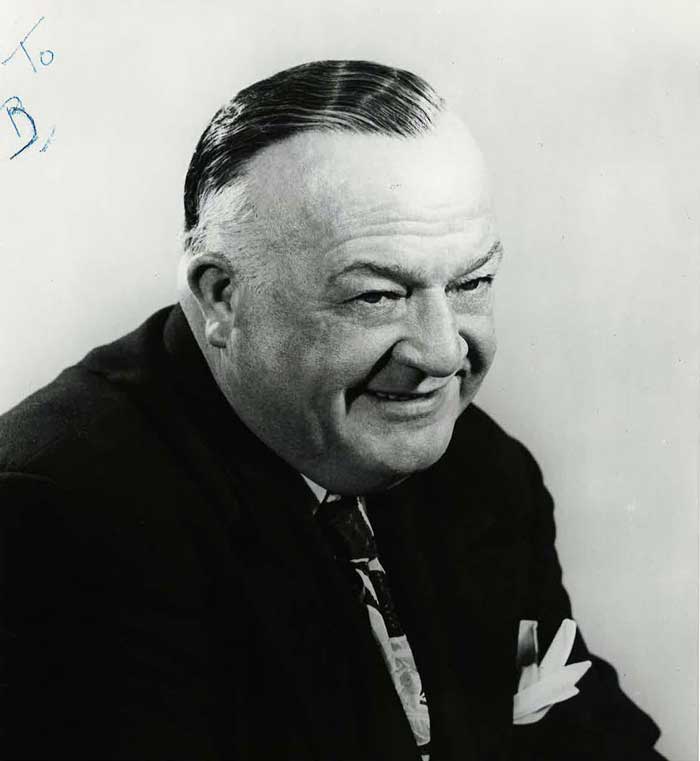
Ferde Grofé, Lynn L. Sams Papers, Special Collections in Performing Arts, UMD
Don Gillis Interviews Ferde Grofé, March 2-7, 1965
American Bandmasters’ Association Research Center, Special Collections in Performing Arts, University of Maryland, College Park
Transcription by Christina Taylor Gibson
Don Gillis: Alright, testing 1,2,3,4, 5 and a half
Ferde Grofé: 6, 6 and a half
[laughter]
D.G.: 7
F.G.: [still laughing] 8, 9, 10, 11, 12, 13
D.G.: Well we’re talking here in the Mayflower Hotel with the Dean of American composition, our beloved friend Ferde Grofé! Ferde, welcome to these microphones and particularly to this ABA, The American Bandmasters’ Association Broadcast.
F.G.: Oh, thanks a lot Don, it’s, I can’t begin to tell you what a pleasure it is to me to be here. After all, I’ve been away two years—it’s a long time for me to be away from the Bandmasters’ Association. Thanks. I’m enjoying every minute of it.
D.G.: You’ve been to a lot of these conventions, haven’t you?
F.G.: Yeah, well, I think it starts with Pittsburgh, about seven or eight years ago.
D.G.: I remember seeing you in Pittsburgh conducting there. You did Grand Canyon Suite!
F.G.: Uh, yeah, “on the trail(?)”, yeah, that’s right for band with the Colonel Whiting, wasn’t that it? The Field Band?
D.G.: It was either the Colonel Whiting’s band or with the Carnegie Tech Band. One of the two
F.G.: Uh, no, no, Colonel Whiting, I remember that.
D.G.: Well, it was a great performance
F.G.: Yeah, they played very well, Jesus,
D.G.: Jesus, well, we got some editing to do there
[laughter]
F.G.: Oh, well, I’m sorry!
D.G.: Oh, well, Jesus won’t mind…. That was with Colonel Whiting’s band, right?
F.G.: Yeah, yeah.
D.G.: Then the next convention I think was in Madison, Wisconsin and I didn’t go there, but were you there with Ray Burstein (?)
F.G.: No, no I missed that one. I was busy, I was very busy. I had like a couple concerts that week.
D.G.: How about the following one after that?
F.G.: Oh, I attended the one in Urbana.
D.G.: Yes, that was the dedication of Dr. Harding’s the new band hall there?
F.G.: Yeah, yeah, that’s right, do you remember that? Beautiful building, wasn’t it?
D.G.: Oh, Edward Kissinger, that was the assistant conductor and Dr. Mark Hindsley was the host of that convention?
F.G.: Yeah, what a host!
D.G.: Yes, what a host. And then there came Perdue with Al Wright . . .
F.G.: Al Wright. That’s the last one I attended.
D.G: Yes, I think that was the last one I attended until this one.
F.G.: That’s right. That’s the first one for me! Yes, two years, I missed it. Kinda my
D.G.: Well, we had the pleasure, the other night, of hearing the first, two movements was it? of your new Hawaiian Suite
F.G.: Yes, that’s right. Yes, Harold, my old pal. Harold did the scoring for band.
D.G.: Harold, Harold is uh, in a strange position in our organization. Not only is he one of the leading Bandmasters of America, but he’s also a leading publisher!
F.G.: Yeah, I know that!
D.G.: With Rubanks in Chicago
F.G.: Yeah, yeah, I know that.
D.G.: And the new Suite. Now tell us something about it! Now we heard two movements, tell us the titles.
F.G.: Yeah, well I, I have done it in four movements and I named them after the main islands of the Hawaiian group. The first was Oahu, the second one Maui, uh, the third movement is entitle Kuwai, and, uh, uh, the fourth and last is named Hawaii. I, uh, by the way, I want to tell you what I did, I did a volcanic eruption. All the whole tones. Something new for me! A new experiment. I had the nerve to do that at my old age! Ha!
D.G.: The first two movements were beautiful. The audience was especially moved with if only, well only they, well they were unsatisfied that the other two were not there yet and we’re all looking forward to hearing the other two.
F.G.: Yeah, I am too. Especially I’m dying to hear that new effect I’ve been trying out in the whole tone harmony. Imagine the whole, well not the whole movement, but a significant part of a movement was in the whole tone scale?
D.G.: If one set about getting a volcano to erupt,
F.G.: Yeah!
D.G.: How does one go about that, Ferde? You’re a composer, tell us just exactly how you make a volcano erupt?
F.G.: Well, see, I tell ya, well see, first of all, I thought of the volcano while it was dormant for so many years, and then, naturally, it must have some lava formations down, way down, in the subterranean depths of the crater, ya know? So I, huh, I started very, well, almost, well, a very slow tempo, and they, and, uh, one note for each bar, one note. So that sort of tells the story and, after my way of thinking, of the dormant, uh, dormant, uh, lava of the subterranean depths.
D.G.: Under the crater.
F.G.: Yeah! And as it slowly rises I have, uh, also the band starts in a low key and it rises up just at the same way the volcano would begin to , would begin to erupt. And it rises higher and higher and higher and higher! And finally spouts out! And that’s when I begin to have my fun!
D.G.: Ah!
F.G.: I have, uh, I started employing the reed instruments, and uh, bursts, bursts of splendor, uh, uh, you might call it that after all the volcano has splendor in its way of, of manifesting itself.
[laughs]
D.G.: Ferde, you’re a master at composition, and a master of instrumentation. And, uh, I’m going to, I’m going to put this line in because I hope by this time the tape will be available. We will enjoy hearing your description of a volcano erupting in just a few moments on this program. And, uh, much of the rest of the suite as we have time for on this program.
F.G.: Yeah.
D.G.: Let’s go back a long, long, time ago. When…
F.G.: When what?
D.G.: Do you remember when you first became really interested in band? I know you have a distinguished career as a cellist.
F.G.: Yeah.
D.G.: And your father was a cellist.
F.G.: Well, my grandfather. But he was formerly associated with Victor Herbert, you know the old Metropolitan.
D.G.: And was he associated with Los Angeles?
F.G.: He was the first cellist in the Los Angeles Symphony for twenty-five years! And my uncle, uh, Julius Brudrick (?) was the concertmaster that same orchestra for fifteen years. And I only, uh, I was a viola player, by the way, I’m not a cellist, I was a viola player. And I, uh,
D.G.: You and Paul Whiteman both, right?
F.G.: Yeah [laughter], that’s right, boy was that, that’s right. And, uh, I went over to the new Philharmonic. My uncle Levi had become the assistant concertmaster Sol Novak was the concertmaster and Henry Rothwell was the conductor and that was, by the way, my last year as a viola player because the next year Paul Whiteman asked me to join his band and I put the poor old viola in the corner and I’ve never seen it since. Haven’t played on it at all.
D.G.: But all this time you were writing and very busy writing and you sort of catapulted into world fame, first of all the Gershwin score!
F.G.: Oh, yeah, the Rhapsody in Blue. Yeah!
D.G.: I was at the Library of Congress the other day and saw that score that you did!
F.G.: Oh, yeah! By the way did you know that the Kostelanz recorded that about thirty years ago, together with the, uh, with the Rhapsody and the Grand Canyon Suite. He recorded when he was on a big radio program. I’ve forgotten the name of it now.
D.G.: Well, this was back in May 1924 when this happened, wasn’t it?
F.G.: Oh, yeah.
D.G.: When they . . .
F.G.: No, no. The initial performance took place in, um, February the 12, Lincoln’s birthday in Aeolian Hall, 1924, that’s right.
D.G.: Okay, well I was right with the year at least.
F.G.: That’s alright.
D.G.: And then, and then there came along such things as Metropolis?
F.G.: Oh, you remember that?
D.G.: Of course I remember that!
F.G.: See they still ask me for that!
D.G.: The greatest, uh, jazz, uh, canon fugue that I ever heard is in that work.
F.G.: That’s right
D.G.: And then the Tabloid Suite.
F.G.: Tabloid and then Three Shades of Blue for piano solo.
D.G.: Yes, and Mississippi Suite, of course, which many,
F.G.: Yeah.
D.G.: Many bands in American play
F.G.: Yeah, uh
D.G.: Especially Mardi Gras and Father of Rivers
F.G.: By the way, Kostalanz refers to that as, as a little cameo
D.G.: Oh, oh, I think it’s a big cameo, it’s not just a little cameo
F.G.: Yeah, yeah.
D.G.: And then, what year was Grand Canyon?
F.G.: Uh, Grand Canyon was premiered in, uh, 1931. It was, uh, Studebaker Theatre in Chicago in 1931, in November, that’s right, November.
D.G.: I remember once in San Antonio, Texas you told me once the story of how that beautiful slow theme of the “On the Trail” movement became written. Uh.
F.G.: Oh, oh, well, that’s when, that’s when, uh, I had my son; he was about a year old and, uh, as he, uh, required his daily nap, you know, and it was my custom, being thoroughly domesticated by that time myself, I’d wheel him very proudly up and down Sheraton Road. Chicago between the Edgewater Beach Hotel and Loyola University. And, uh, about half way between there’s a big apartment house and some shade trees there and it was a summer’s day and it was hot and I was perspiring and, the, in this walk, I was supposed to lull my little son to sleep, but he wouldn’t go to sleep that day. So I finally stopped in front of this apartment house and rested. And I started pushed, like you would a perambulator, pushing back and forth, and out of the east there just came [starts singing] da-dee-da-da. Da-dum-pum-pum. I don’t know! It just came to me that way. So it’s just really a lullaby.
D.G.: You think it’s good advice for me to get a baby buggy too?
[laughter]
F.G.: Nooo.
D.G.: The wonder of that. I think that “On the Trail” was one of the first of the transcriptions that made its way into the band field. Wasn’t it? Back in the mid-30s.
F.G.: Yeah.
D.G.: Shortly after it had been written,
F.G.: Yeah. Say you’re, you’re very well versed with my background!
D.G.: Well, pretty. I was at Texas Christian in those days as band director
F.G.: Oooh, I see.
D.G.: And Whiteman came down in that direction
F.G.: Yeah, he was down there, I remember that.
D.G.: And I got hold of “On the Trail” quite early and also “Mardi Gras” but, uh, what happened next? What was your next big band number? ‘Cause there were a lot of them that came out around about that time weren’t there?
F.G.: Uh, yeah, well. “Oh the Freedom! Oh the Freedom!” That’s the glory Hallelujah, ya know. I based the, I wrote that really on the text, followed the text and I, gotta, I was inspired by, what’s her name that wrote that? Uh. What’s her name again?
D.G.: I don’t know. I can’t remember it at this moment myself, but she did write a beautiful, beautiful tune. Um the text. I don’t know who wrote the tune.
F.G.: Yeah, well, it provided me with a lot of inspiration anyway. Well, that’s. Well I wrote a lot of things, I can’t remember all of them, but, uh, that was one of the first ones. And then I, uh, I came, let’s see, uh, Death Valley.
D.G.: Oh yes! That’s Death Valley Suite.
F.G.: That’s published in suite form.
D.G.: Yes, that wonderful storm scene in Death Valley with the wind machine.
F.G.: Oh. Yeah. A little bit different than the cloud burst in Grand Canyon Suite. I, uh, well, I thought of the little whirling dervishes, you know, spiral, you know, spiraling around, and I thought, that’s how these darn things are born! They start in a small way and they go around and get bigger and bigger. That’s how they . . . and finally this last one it gets so big it crashed against a canyon wall, in the middle of Death Valley, I think it happened, and it broke off a boulder and it rolled down the mountainside and crashed to death. I ended the storm scene with a big crash.
D.G.: You had another wonderful crash in your Hudson River Suite. Was it called Hudson River? Or was it
F.G.: Yeah!
D.G.: It must have been bowling balls.
F.G.: Yeah! Rip van Winkle.
D.G.: There was some musical crashes.
F.G.: Yeah! D’you remember that?
D.G.: I wanted to steal from you I remember at the time.
F.G.: Aw! Don’t tell me you’d steal it!
D.G.: And, uh,
F.G.: I don’t believe that!
D.G.: Well let’s come back to the . . . well, I promise I won’t steal from you.
[laughter]
D.G.: I just wish you had written home to your mother asking if [I had written the tune?]
D.G.: Let’s talk, in the remaining time that we have about this whole business of bands. Now you, you began
F.G.: Well I started out as a kid, you know. I played in bands when I was about 16. 15, 16, 17. My grandfather was the, uh, trombonist, the principle cellist in the L.A. symphony, but he was also the trombonist in the, uh, 7th regiment band stationed in Los Angeles. And, uh, we had a whole section of band in my family and they were all named Durand. You know the old French brass. Well, I started with the Althorn, the peckhorn we used to call it, the rain catcher?
D.G.: E-flat alto
F.G.: Yeah, that’s it. And they started me out on that and, uh, and I remember I donned my first uniform. Oh boy, I was [f??], brand new AF of M uniform I don’t know
D.G.: It had some red in it and a little gold . . .
[laughter]
F.G.: Yeah, that’s it. And by the way, I composed a march.
D.G.: Did you?
F.G.: For 1909, for the Elks convention.
D.G.: Was this the first, the first band piece you wrote?
F.G.: Yes, the first for band, imagine that? That’s the first thing I wrote. It was for band. It was a march called “Elks Grand Reunion March” and they still play it!
D.G.: Is that right?
F.G.: Yeah, I was on a radio program, was it during 1935 with Burns and Allen and one day in my. One day one of my trumpet players came to me and said, “I remember played a march of your in our band, Exposition Park Band, and it’s called Elks Reunion March and I was just wondering, maybe you’d like to be a guest conductor some afternoon?” So, sure enough, I went out there, and there it was, my little march, and I hadn’t played it since I was a kid, seventeen years old, and gee, I was surprised, it sounded pretty good!
D.G.: I imagine if Grofé wrote it, it did, whatever your age was!
F.G.: Yeah.
D.G.: Let’s, uh, let’s talk for just a minute about. I’ve seen you at so many meetings, Music Educators and Bandmasters Associations, uh, in the past thirty years, since you’ve been watching this thing, what seems to be the most significant thing that has happened to the band music of America?
F.G.: Well, first of all, I think radio play is a very important factor, and as well it’s showed a chance to have band concerts over radio, I think it’s helped a LOT. And I think the band will be what it was, many years ago, very popular. During my early years, I remember, the bands were very popular. Gilmore’s Band, Meyers, all the famous bandmasters, and they enjoyed great popularity then and I feel very sure that it’ll attain the same prominence as then. Don’t you think so?
D.G.: The instrumentation is so much different then than now though. You have so much
F.G.: Oh, yeah! Oh, my! No comparison, yeah! Oh, yeah, the addition of all the new instruments has helped a lot.
D.G.: We have a mutual friend named Sigmund Romberg, I think you . . .
F.G.: Yeah, Romy? Oh, yeah!
D.G.: Romy used to say, “you’re not a composer until you can” [tape cuts out] Well, our mutual friend Sigmund Romberg once told me that, “you’re not really a composer until you can go into a small American town and hear some kid that you never saw before walk down the street whistling one of your tunes.” And I think Ferde that you’re qualified because of the many wonderful tunes you’ve written and you deserved all of the accolades as the American composer because everybody whistles Grofé tunes.
F.G.: Aw, you really think so?
D.G.: I really think so!
F.G.: Gee, what a world, my God! I can’t believe it! I don’t realize this.
D.G.: I think that I speak as a member of ABA and you also as a member of ABA and we’re sort of lucky even, as composers to be in this organization, aren’t we?
F.G.: Yeah. Isn’t wonderful that they took us in?
D.G.: Yeah because we can’t—you can—but I can’t shake a stick like they can, but let’s just say that now that we’re in, that we, speaking for myself, have a tribute to pay to the American Bandmasters Association for providing such things as do exist.
F.G.: Yeah, that’s right, 100 percent, I agree with you there.
D.G.: Ferde, I’m going to pretend for a minute that I’m a young bandmaster.
F.G.: Yeah, a damn good one too.
D.G.: And I wish I were a young bandmaster. I’m going to pretend that I’m coming to Ferde Grofé and saying, “I want to conduct and to compose.” What kind of advice would you give me? How can I best get ahead in this world of music?
F.G.: Well, all I can say is “Go West” in an unusual way. That famous, uh, West,
D.G.: And?
F.G.: And follow the, well, I could call it the narrow path or straight path
D.G.: Or on the trail?
F.G.: Oh, no, well, yes, yes, yes, I b’lieve in that, that’s very well put.
D.G.: Thank you Ferde.
F.G.: Oh, not at all.
D.G.: And on this program where, we’re going to be playing your music, we thank you not only as a man of music, but as a man who loved bands enough to create things such as this for us.
F.G.: It was many years ago, God bless such things as the American Bandmasters [tape ends]