
John P. Paynter Interview
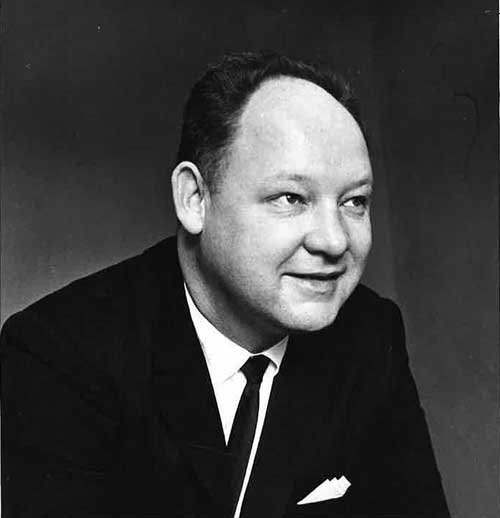
John P. Paynter, ABA Personnel File, Special Collections in Performing Arts, UMD
Download Interview Transcript (.pdf)
Don Gillis Interviews John Paynter, March 2-7, 1965
American Bandmasters Association Research Center, Special Collections in Performing Arts, University of Maryland, College Park
Transcription by Christina Taylor Gibson
John Paynter: Another area that you might be curious about, if hasn’t been touched on by Karl or some of the other people, I’m extremely interested in this community band thing and I have a community band of course and um
Don Gillis: Let me ask you,
J.P.: I think there is a future for that.
D.G.: What’s always bothered me, we train like [cut off] are you a doctor?
J.P.: No.
D.G.: Do you want me to give you a degree real quick?
[laughs]
D.G.: I’m talking with John Paynter who is director of bands at Northwestern University in Evanston, Illinois. Do I say Evanston, IlliNOISE or Evanston, Illinois, John?
J.P.: Well, I think if you’re from New York, as you are, you say IlliNOISE, and people will know you’re from New York.
[laughs]
D.G.: Well, I’m from Missouri so I’ll say Illinois to be correct here. Um Evanston, the campus of Northwestern is north of Chicago . . .
J.P.: Yes Evanston is the first suburb north of Chicago and we actually have a campus on, in two places, we actually have a Chicago campus and an Evanston campus but of course I’m concerned only with the School of Music which is located on the Evanston campus.
D.G.: We will be in Evanston next year for our ABA convention and you will be our host and the, uh, Northwestern University will be our host university. Ah, we appreciate that. What are some of the plans you have for next year’s convention or have you really thought in detail yet?
J.P.: Actually, we’ve done quite a lot of preliminary thinking, Don, because we consider this to be a marvelous privilege, the opportunity to have an ABA convention is a doorway to presenting some of the really great men in the band field to our young college students. And, uh, I think that whatever effort has to go into the convention has to be greatly rewarded having these people on our campus and working with our young musicians.
D.G.: You’ve had one of the great band men on your campus all of these long years in, um, in Dr. Baynum!
J.P.: Yes, yes that’s definitely true. I owe him, really, everything that I have been able to achieve with the band there at Northwestern.
D.G.: John, let’s just talk for just a moment about some of the men that we’ve been meeting at this convention that we will meet again next year. Let’s start off with Frank Simon. We’ll just name a few of them . . . who else can you remember?
J.P.: Oh, there are so many! My goodness, there have been so many who have been national figures! Frank Simon, of course, and Karl King, the great march composer and conductor, and the, uh, wonderful military conductors, Col. Santelman, Com. Brendler of the Navy, and uh, you can just go right down the line. Harold Bachmann and so many who have really represent the history of band music in the United States.
D.G.: And then there’ll be conductors from the other big ten schools?
J.P.: Yes, that’s r-
D.G..: Such as Mark Hindsley who was once past president!
J.P.: That’s right, the big ten is strongly represented in the ABA, I believe we have nine of the ten men in the ABA.
D.G.: I think we should get the other ten in there and make it
[laughter]
complete. We have the cream of the crop at this organization. Now, as a non-conductor, as a non-band director, I can say this, you see, where you can’t, but you can agree with me that within the membership of this organization who will convene next March uh ninth or something around that period
J.P.: That’s right.
D.G.: in Evanston next year will be the great men in the tradition of John Philip Sousa, but who have through their own initiative, developed
J.P.: This is so true, men who have written, really written the history of band music in this country.
D.G.: John, you’re an awfully young man to have such a responsible position as head of a big ten school and conductor of bands. You’ve been there as a band director for, how many years now?
J.P.: Uh. This is my twelfth year as director of bands
D.G.: I think you told me that you were, you started at Northwestern when you were twenty-three years old?
J.P.: That’s right. I had the very good fortune of following in the job that Mr. Baynum had had for some twenty-seven years at Northwestern and uh, it was a, an opportunity that I really don’t believe very young men have had. It, it was just one of those freaks, I happened to be there and available and, uh, the opening came, and I’m grateful for the fact that Mr. Baynum strongly recommended me to succeed him and the administration thought that would be a good idea.
D.G.: Well of course you’d been a member of the band. What was your instrument?
J.P.: Well, I was a clarinet player in the band, although I always sneaked around, I played a year on oboe with him and I played a year on tuba and uh
D.G.: How about bass drum?
J.P.: No, I, I would never even be seen close to a bass drum in the same band with Mr. Bainum!
D.G.: Guess that’s a no.
J.P.: But, uh, my background, uh, was largely in composition and theory. Both my degrees there were in composition and theory and I took over the band for a short period of time while Mr. Bainum suffered some illness and then when he was back in good health they asked me to stay on as an assistant to him and, uh, I did this for two years after my graduation and then took over the band when he retired in 1953.
D.G.: Now had you, as a composer, done much work for band?
J.P.: Not a great deal. I had done some, uh, mostly in the area of arranging for the marching band, and, uh, I had written a couple of concert pieces, for the band, but as all of those who are in composition seem to get oriented, they pushed in the form of other forms of expression, I managed to turn out a symphony and a number of things for chamber music and some vocal music. But my real opportunity for writing for band was there and I didn’t capitalize on it.
D.G.: But you did. I know you have written for band, and because you’re a modest man I won’t even ask you to tell me about it, but I have seen it at work and your championship of the American composer. The College Bandmasters association the CB…
J.P.: CBDNA
D.G.: CBDNA, I was fortunate enough to attend one of your clinics one day where you were reading through many, many new scores and this is, this IS a practice of your isn’t it?
J.P.: Yes, very much. I have great interest and faith in the, uh, young people and American composers of all ages who have taken to writing for band and uh, at first some encouragement was necessary. It came long before my time from other conductors, and I think that we should continue that encouragement because we are deriving great benefit from these scores of young composers and some marvelous things have been uncovered.
D.G.: John, you know, I’m gonna pose a little hypothetical situation to you here. A young player, having successfully passed his college boards and all and he comes to you, a very, very fine musician and he now joins the Northwestern band and he stays with you for four years and is a fine clarinet player, we’ll say, and then he goes, he isn’t, he isn’t going to be a band director, goes back to work in his home town and maybe with his father in a factory or whatever. In other words, he isn’t going to make a career of music. What happens to him? What happens to all the skill? Where, where is he going to play when he gets back to – you name the town because it exists in almost every town?
J.P.: That’s right, that’s right. This is a concern and should be a concern of all of us who teach that we are developing a number, a large number of skilled players at all, all instruments who don’t necessarily find the opportunity to continue playing when they finished their college music-making days. I, I think I should probably say first of all, not all is lost if they never play again, of course, because our fundamental job is to teach how to play music not how to play the clarinet, and whatever rubs off in the way of musical training should last these people a lifetime in terms of their pleasure in music, their taste and selection of music, this kind of thing, and I hope that this is going to be an important factor. But I really think we ought to have some serious ambitions for providing the way for these people to continue playing on their instruments after they leave college. Uh, I have experimented some in my own area there around Chicago with a community band and there are a large number of community orchestras and uh, I find with, uh, just a minimum of effort, one of the most exciting experiences I have had, uh, to make music with adults who, uh, have not incentive of playing other than the love music and the joy of playing good music. Uh, this is outside the bounds of professional music; they’re not to be paid, they don’t intend to, they just love to sit down, once a week and make music as an adult form of recreation and pleasure. Uh. I think there needs to be a rebirth of interest in this kind of music-making at the adult level.
D.G.: You know, so many of our band directors, when you first talk to them, these are the fellas just fresh out of school, and they, they seem, in one sense to want to use the band as a stepping stone into something which they might consider a little more glamorous, the orchestra. Do you, do you find within the last few years that this trend has reversed itself and there is much more pride of podium for the band than there was, say, when I started out at twenty-three/ twenty-four to be a band director and you started out at twenty-three?
J.P.: I think there is, I think, to be perfectly honest, in a young, uh, impressionable mind there is still the possibility that the orchestra, with its four-hundred years of tradition for music has to be explored by these young players and I am never offended if a young musician shows more interest at some stage of his development for orchestra than he does for band because I know he’ll be back.
D.G.: hmm.
J.P.: Uh. They find excitement, as they should in this great literature for orchestra and I think the nice thing that we are discovering is that they’re finding a parallel situation with the band. There is just equally an exciting medium of performance there. Now, I’d just say, just in passing that it has been interesting to me to see the number of adults who have had wonderful year of experience playing in orchestras around the Chicago area coming into our band and leaving these orchestras because they want a new and different experience with the band.
D.G.: You think part of this is because of the wider variety of experience in playing that they can get? Or experience in conducting, experience in conducting that they can get rather than the confined literature of the symphony orchestra?
J.P.: Yes, I’m sure this has a lot to do with it. The variety of music that we can play, the newness of the music! This is something that we can’t underestimate, the fact that almost every week, if we wanted to, we could introduce a piece of literature in the rehearsal that someone in the band had never played before, uh, and then as you, as you have indicated, there are many, many opportunities for them to actually conduct and create, to write for the band and have their music played, and these are all exciting things to a creative person.
D.G.: I recently read the staggering figure of something like six-hundred band pieces, new band pieces, being published every year. There must be . . . how many more would you hazard were being composed?
J.P.: [laughs] I just have no way of knowing the total. I, I am sure that it is at least six-hundred that are published Don, because, as I think you know, I do a review column of new music and each month a huge stack of music crosses my desk, music of all kinds, from what we call grade 1, for the youngest of the players, up through grade 6, the most mature of the players. And much of it is not good music. We, we don’t pretend that it is, but, uh, there is, at least in the band, the opportunity to be discriminating in music. We have the chance to experiment and to discard those thing that are not worthwhile and, uh, just to take the very best and work from that point.
D.G.: How much more time do we have?
Unknown: I’m going to take out another reel.
D.G.: Well, do we have three minutes?
Unknown: No.
D.G.: Have great fun with you, um, Arthur, before we quit.
[tape cuts]
D.G.: What’d we been talking about, we’d been talking about community music and
J.P.: Uh-huh. I think that’s where we are.
D.G.: Oh! The cultural explosion! You’re talking about all these magnificent things that are happening, in new music, in creativity. This is, uh, happening in the band field almost, our explosion is almost louder, almost louder than any other form, isn’t it?
J.P.: I think it’s an integral part of the, ooh, cultural explosion and population explosion.
D.G.: John, let’s just go way out on a limb and hazard a few guesses here. Let’s go back, you started when you were, uh, twenty-three and I started back in, we’ll say 1930, playing at Texas Christian Band. You’re at Northwestern, a little later. Since 1930, how many people, do you think, have been members of bands, all over the country?
J.P.: Oh my goodness, uhh, how could we ever arrive at a figure? It must be 50 million? 100 million? I don’t know. I’ve heard them say there are 17 million youngsters right now on instrumental music and, uh, there’s a tremendous impact. Uh.
D.G.: We range from 50 thousand band to 20, 26 of various degrees, but we have 50 thousand. Let’s just say we have 10 thousand bands a year and we have 70, let’s say 50 people in the band. This adds up to your 50 million pretty quickly doesn’t it?
J.P. I think, I think it does. I think a curious figure at our University. Right now we know that more than 40 percent of the students who come into our school from all fields have had instrumental background, more than 40 percent in one University. And, uh, I’m sure that this is duplicated all over the country.
D.G.: John, how can you account for the fact that, with 50 million, we’ll just cut it down to the 50 million mark, how do you account for the fact that there are no consistent band programs in radio, or on television, or on records. Why, if we have this potential mass-buying public of this, this, of millions of people, why aren’t served better with band music on the air or on recordings.
J.P.: I think, uh, one point has to be, Don, that we as band directors are somewhat at fault. I think that we, uh, have done a wonderful job of educating in music through the use of the band and in promoting spirit and interest in music in the communities that these school serve but we have been far less interested in seeing that the top level performing organizations that would be comparable to the major symphony orchestra and so on would exist in bands in this country, and we do have some fine organizations, we have the Goldman band and the Leonard Smith Band, the Los Angeles Band, but these are the only three that you can name that are professional bands. We need professional bands of standing and I am sure that if we have these bands and if we play the right music with them and play it well as we know we have so many people capable of doing, that the American public that has been brought up on bands is going to just yearn for this music on the air and on television and wherever they can get it.
D.G.: Why don’t we just confidentially ask them to start writing into the networks and say come on let’s have this music that we grew up on and that we knew and love.
J.P.: I think you would have an overwhelming response. I think you would.
D.G.: I wanna close our interview with a reference to our American Bandmasters Association research library in, um, in Maryland, College Park, Maryland, the University of Maryland. Uh. When we were visiting it recently we saw exhibitions of material that had been given to us with, say the effects of Patrick Gilmoure. What do you think that the American public should look for in their closets and in their scrapbooks which should, which might be of interest and of permanent interest in the form of archives, for us than it would be for them in their own little living rooms?
J.P.: Well, I think most anything. The wonderful thing about the American band movement is that it has history in every community and city and village and country school clear across the country. Uh, there’s nothing that is too insignificant to send to this archive. Uh. I’m sure that the librarian there would be perfectly happy to receive pictures or old scores, copies of programs, old instruments, and I know that these things exist all over the world and particularly in this country where we have had so many bands for so long and we could have them there in that center. It’s a wonderful thing for me to see develop because for a, as a neophyte in the band world I have to get a certain amount of my history this way. I, I didn’t live with all of these wonderful men who started bands in American and I certainly think that this is long overdue project and a most worthwhile one.
D.G.: Let’s think of one other way to quit. Something with a welcome to people to the area around Northwestern. Lemme sum it up with this question: John, we’re all looking forward to the meeting in 1966, almost a year away, at your school, and, uh, oh that’s very badly put. John, there’s one other reminder of the people in your area, will they be invited to the concerts when we have the next American Bandmasters Association?
J.P.: They most certainly will. Of course one of our reasons to desire to have the convention there is to give the people in the Chicago area the opportunity to come out and hear these fine bands and, most important, to see the great names in the band world as they conduct the bands. And, uh, I hope even to applaud them for the wonderful things they’ve done for this country.
D.G.: Most of these will be right on the campus?
J.P.: All of the programs will be held right on the campus in our, uh, University Kahn Auditorium and uh, they will all be open to the public without admission charge and we will hope that the hall is packed for every single program.
D.G.: It’s a wonderful program, and as they say on the radio, consult your daily paper for time and place. Thank you John.
J.P.: You’re very welcome.