
Vaclav Nelhybel Interview
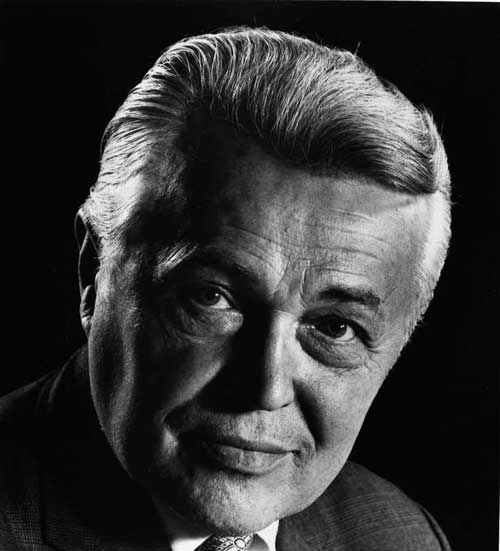
Vaclav Nelhybel, Midwest Clinic Archives, Special Collections in Performing Arts, UMD
Don Gillis Interviews Vaclav Nelhybel, March 2-7, 1965
American Bandmasters’ Association Research Center, Special Collections in Performing Arts, University of Maryland, College Park
Transcription by Christina Taylor Gibson
Don Gillis: I don’t think so, I think it’s pretty powerful. How do you say your first name?
Vaclav Nelhybel: Vaclav, Vaclav
D.G.: [repeats name] This is an interview with Mr. Vaclav Nelhybel for the ABA no. 5 of aseries of interviews. Welcome, uh, Mr. Nelhybel, not only to the American Bandmasters Association group, here in this convention in Washington, but into the field of band music in some of the most exciting and powerful new music we’ve, all of us have heard in years and years.
V.N.: Thank you.
D.G.: Tell me your background. Now you come from Europe.
V.N.: Well, I’m born in Czechoslovakia and came in 57 here instead
D.G.: And you’ve been in the United States since
V.N.: Since 57. Yes.
D.G.: Well, now, one who writes so beautifully for band, uh, must have done something before his pen scratched that first band score.
V.N.: Yes, a little bit. I started composing very, very early, you know twelve, thirteen years, and composed quite a bit. I had one opera performed when I was twenty-six years old in Prague national theatre, two ballets, one in Zurich, one in Copenhagen, well, symphonic music, chamber music, quite a bit still being performed in Europe and published. And, uh, before I came to the United States, I left Czechoslovakia in 46. I was invited as conductor to Swiss Radio Orchestra Geneva and same time I was teaching in the university in Freiburg, Switzerland. Then I became musical director of Radio Free Europe, the American radio station in Munich, and from there in 1957 I left and came here. Well, exactly two years ago, I met, I met the first contact with, I don’t know, the field of school music. I didn’t know there is something like a band in the school or orchestra.
D.G.: You don’t have any of this in Europe?
V.N.: It’s non-existent. There are in Czechoslovakia there were perhaps three or four what are called Gymnasium, it’s a kind of high school, where they have something similar, but they are far from being the same. It was in Atlantic City in the original convention that I saw,
D.G.: Yeah, the MENC
V.N.: Yes, that’s right. And finally, I made kind of surveys, kind of research. What are the kids who played, I mean on the Jr. High School level. I knew there are college students who can play, I mean anything, and went to, in the summer, I heard, again, and again one name popping up, Dr. Revelli, you have to meet him, you have to go there, we are going in the summer. I went and there I had the chance to hear my first piece for, for band called Chorale, which is being published now. And well, some people said it’s different, the reaction wasn’t too bad, and Dr. Revelli, he said, if you had something for band, think of us, we will perform it.
D.G.: This was your first, then, your American premiere as a band composer, was it?
V.N.: Well, this was just a sight reading session,
D.G.: I see, under Dr. Revelli.
V.N.: Uh, this, no, no, this I conducted in this sight reading session, just read it through. And then Dr. Revelli said, if you have something, so then I wrote Trittico, which was performed two days ago here.
D.G.: Mmm-hmm. Well, you heard the American band and then just had to write for it.
V.N.: Well, eh, ya, I was, I was already tempted because em, I played myself with the exception of oboes and bassoons, or clarinets, all the brass instruments, so I was always kind of a man of wind instruments. And this fantastic, fantastic potentialities which were there. I was fascinated by it because in Europe they have bands. They have bands, like I say, Italian bands. They have the instrumentation which is much richer than the American, but the
D.G.: By richer, what do you mean?
V.N.: Many more, more different instruments. I, just, a high a-flat clarinet, is something what exists, then the generally the European bands have the differentiation in the brass. They have full brass families. Uh flugelhorns, alto, tenor horns, baritones, tuba, and trumpet, and so on. And so, what I did, I first tried to get as many recordings as possible, what has been composed, what has been recorded, and studied scores, and then, took about three months. Then, then I tried to find, where am I in it? I mean as composer, what is my response- I didn’t want to write something as it has been written because there are certain clichés of course. It’s not the same thing as symphonic music, the scope is absolutely, it’s individualistic. And there there has been, because it was meant for people, so somehow everybody was having at one, at one aim, but in symphonic music, everybody tried to express HIMself. (yes) And so, that’s what I tried, I tried, am trying.
D.G.: There’s an amazing difference of philosophy there, the fact that, that, in symphonic music one tries to express himself of a mood, of a thought, of a philosophy, but the awareness, as you pointed out, on the other side, of the conductor, and on the other side of the sound, there is a pair of ears which represents something for which you must be very much aware, beyond what’s in the score, and you recognize this from study of scores and from listening to our bands?
V.N.: Well, I tried. I don’t know if I achieved it.
D.G.: Well, I think the applause at the concerts on which we’ve heard your music at this convention certainly proves you’ve achieved it. How many compositions have you written for band?
V.N.: Oh, well, I think about seven.
D.G.: And are they all published yet? Or will they be shortly?
V.N.: Eh, well, Trittico is being published, the Chorale, the very first, actually Chorale was the very first, Prelude and Fugue, which was performed yesterday was the second, Trittico was the third. So these three are being published.
D.G.: Have you had a chance since 1957 to go about the United States, into the high schools, into the colleges?
V.N.: Yes, first, I mentioned, I dropped the word, you know, the big word “research.” I went, really, to Jr. High School, the Jr. High School Bands and watched them, three or four. Then, wrote kind of experimental eight measures, sixteen measures, sections and tried with others. So I was, with all, at least twenty-six different places.
D.G.: Oh, wonderful.
V.N.: And, uh, somehow I tried to come to my own conclusions. Uh, yes, of course, I, my biggest experience I had quite at the very beginning was in Ann Arbor, University of Michigan, first summer and the summer after too. And, uh I conducted some of few big band festivals, one orchestra festival and, em, and was invited as guest conductor in Kansas, Pennsylvania, so some kind of idea I have already, because the United States is too big.
D.G.: Here’s a, perhaps a personal and also a peculiar question, you spoke of being with the Orchestra de Swiss-Roman, here is the quintessence of perfection as far as performers are concerned. Okay we move you now, 3,000 miles into our direction, and we find you in a high school somewhere in some town. Now what is, what is your philosophical approach with these youngsters? What happens to you as a conductor?
V.N.: This is a horrifying question. What, when I was invited for the first time to conduct a district band festival, I was never so, in my life, never so, at least I don’t recall, might have been, never so scared, as before going on the stage. [laughter] And you know what happened? It was in Aimsville(?), Pennsylvania, I came on Thursday night, I have good friends there, Frank Stuchow, who actually really pushed me into this whole thing and brought me to Dr. Revelli, and so. I was located in a wonderful motel, I woke up in the morning, and [whispering] I had no voice.
D.G.: wow
V.N.: This MUST have been mental. Absolutely no voice! There was no reason for it! I am not, I don’t suffer, you know my throat is perfect, I, I never have it. Absolutely no voice, must have been mental block. So what happened? I had to talk through an interpreter. I was whispering into the ear of a boy and he was telling them, after ten minutes I got mad and starting screaming in my whispering voice and finally the voice, somehow, came so that I could communicate! It, it was much tougher for me. I couldn’t, I was even singing and whispering.
D.G.: Well, this wasn’t, this wasn’t a fear of just youngsters, not these hardened professionals.
V.N.: Nah, it’s not, what, but I was there with myself, and I didn’t want to be a failure.
D.G.: Ah, yes, yes.
V.N.: Because I spend very much time! If I put together all the time I spent, I wasn’t paid for it! No foundation, no nobody. I, I was interested. I had certain image of these kids—what they could achieve. How, uh, what they could grasp, what they could physically and so and so and so. That is one thing. Second I thought I am a wise guy who knows how to write for them, or I know how to make them play certain things. And not only play, and I don’t mean technically play, because they are fabulous very often, but how to project music. And I wanted; I didn’t want to fail! I didn’t want to be a failure after three days, I wanted to project the musical content of it and to make them, to go through a certain emotional, emotional experience. Because what for the kids come together if they don’t get something from it?
D.G.: Hmmm.
V.N.: Especially from somebody good—I have a certain technique, I have conducting technique, twenty-five years of musical experience, and this was the fear I had, and, ah, somehow, well, I was scared the next time again, and I will be scared, probably, every single time in my life! [laughter] Because
D.G.: As if they’re threatening
V.N.: Because I know many perf-performers world-wide, fantastic names, and they are scared every single time before they go on stage and it’s… because if you try a little bit to do your best, you are concerned very much and this. . .
D.G.: Yeah. You know I think it is a great tribute to us that you, with your musical background have dedicated yourself to, not only to writing, but to this, this attitude. Better that you approach our young people, and now your young people, your fellow Americans with this, this desire to give your best.
V.N.: Well, this is sheer egoism because, very simple to explain, I’m not just using words. Everybody wants to get the satisfaction that he is import—not important, but he did achieve something, not important in front of people, important when you are alone at home or traveling in the car, that you feel that I really it has sense of value. And I think that really in this field it is fantastic how fast you can get it! And there are so many enthusiasts here. No, eh, who really want to, want to become better, and want to do work for it, you know! And they spend time, evenings, everything. The people are wonderful! I, I somehow I love them all! And, for example, what is my function, I am a composer who comes and they applaud me and they say it’s wonderful and so on, so I am a star! BUT, the high school and junior high school conductor who is there Monday through Friday and plays in front of parents and so, and perhaps he comes once to a district or some convention or so and so, these are the heros! I have fantastic admiration for them. These are wonderful people to be affiliated with!
D.G.: I think we can sort of wind all of this up by both of agreeing that the real hero of the music profession in the United States is not the man on the podium of the philharmonic or the Philadelphia Orchestra, but he’s the man in Wasahachi and Glenco and places like that
V.N.: Positively, positively, they are, very often, wonderful people. And I come an hour. Heavy accent, I don’t know what, and there is {snaps} contact immediately. Old friends.
D.G.: Well there are new horizons for you now, and, uh, new horizons for us, as, as band people, since you’ve arrived. You need to say the last word in this interview, which is something I hope which will be about what you intend to do, uh, for the future of American bands. What are your goals?
V.N.: I don’t know. My goal is to go tonight to New York and then I will see.
D.G.: To write?
V.N.: I don’t know what to answer, I mean,
D.G.: But you do intend to keep on writing?
V.N.: Well, certainly, certainly. Positively.
D.G.: Why don’t you say that.
V.N.: I became an addict, really to it. To the people in the field.
D.G.: Great ending