
Karl L. King Interview
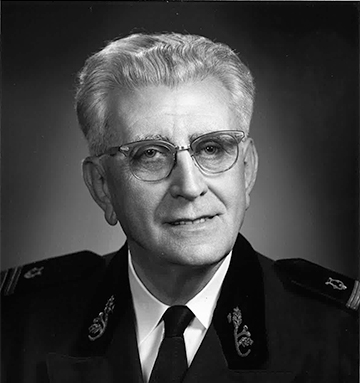
Karl L. King, ABA Personnel Files, Special Collections in Performing Arts, UMD
Download Interview Transcript (.pdf)
Don Gillis Interviews Karl L. King, March 2-7, 1965
American Bandmasters’ Association Research Center, Special Collections in Performing Arts, University of Maryland, College Park
Transcription by Christina Taylor Gibson
Don Gillis: Talk
Karl L. King: Talk what about?
D.G.: Well, first of all, we have to get a voice level, you know.
K.K.: Well, my voice is not the best . . .
D.G.: I’d like it a little closer to King, not to me [indecipherable]
D.G.: I’m talking with Karl King. The only composer in America who I know who’s has a bridge named after him. A man who has written so many wonderful pieces of music, that to even mention them by name would consume most of the time on this program. I’d like to start right off Karl, by asking, what’s your favorite of all the pieces that you’ve ever written?
K.K.: Oh, I’ve never had exactly a favorite. I suppose my most popular number in the public is that old Barnum and Bailey’s Favorite March but they always hang one thing on you. You think of Strauss you think of the Blue Danube, you speak of Sousa you think of Stars and Stripes, and the average composer gets one number hung on him.
D.G.: If he’s lucky.
K.K.: Yes, if he’s lucky and I have been lucky. I wouldn’t say it’s my favorite, but,
D.G.: But it’s the one the public seems . . .
K.K.: The one the public seems to know more about than anything else.
D.G.: You know, uh, I’m a, uh, beginner in this whole business in the American Bandmasters’ Association. I came in, I think in ’56 was my first year. How long have you been a member of the American Bandmasters’?
K.K.: Since the first convention at Middletown.
D.G.: Middletown . . .
K.K.: I was not a charter member, that meeting was held before that convention, but I was one of the few still left who attended that first convention and…
D.G.: Tell us about some of the people who were there, besides John Philip Sousa.
K.K.: Well, Sousa, Goldman, Walter Smith, the famous cornetist from Boston and, uh, Harding,
D.G.: That was Dr. Harding from University of Illinois
K.K.: And Glenn Bainum was there at the first meeting
D.G.: [???]
K.K.: I remember the only two university or college men we had at that first meeting. And Jim Harper was there. I think he was the only one . . .
D.G.: Jim Harper had a small band in North Carolina?
K.K.: North Carolina, but a very good high school band. I just can’t remember all the, Henry Fillmore was there of course, and, uh,
D.G.: The man who wrote molasses trombone and sally trombone and
K.K.: And some mighty fine marches along with them.
D.G.: Yes
K.K.: And, of course, the leaders of the big service bands in Washington were there.
D.G.: Yes. And Arthur Pryor, wasn’t he there?
K.K.: He didn’t attend that first convention, but he came to the next two,
D.G.: What about men such as Gilmore, were they in
K.K.: Oh, Gilmore died in about ’82 or ‘83
D.G.: And this first convention was about what year?
K.K.: 1930
D.G.: And this was when Dr. Simon conducting the
K.K.: Armco Band, he hosted at our convention and the convention would never have gotten off the ground or the organization succeeded if it hadn’t been for the magnificent way that he handled that first convention, making everyone happy and acquainted with each other and friendly and he passed out the honors evenly to everyone so no one felt hurt or slighted and there was a spirit established there that, without Dr. Simon, I don’t think the thing would have gone over. It was just a masterful way he had and all that. Then having Mr. Sousa there of course to bless the whole proceedings really got us off to a great start.
D.G.: What in the world is the American Bandmasters’ Association anyway? Now, I know a little about it because I’ve been a member for a few years, but what do you
K.K.: Well,
D.G.: You’ve been a member a long time, but my aunt Connie up in Karum, Missouri doesn’t know yet maybe.
K.K.: Well, eh, it was originally conceived of by Goldman and Harding I think had a lot to do with it and Victor Grabel, he was secretary at the time. I think that originally it was practically all professional bands. There were more then and we didn’t have many of the educational men and, as I say, there were only two college men and there was Jim Harper, he was probably the only high school man at the first convention. I think Archie McAllister came in a year or two. Originally it was supposed to be made up of professionals, high-class professional men. It was supposed to be, I guess, a little bit of an organization for those who were presumed to be the best of the band field of the time, and I don’t know as the ideals have changed much since. Our membership has changed now where the professional man is very much in the minority because there aren’t too many of us left, see.
D.G.: I see, the economy of the times!
K.K.: Yes, and uh . . .
D.G.: The educators now outnumber, however, there are nonetheless, a number, still, of municipal band directors
K.K.: Oh, yes, and uh . . .
D.G.: And I like to think of the service bands almost as being the professional bands.
K.K.: Oh they are, very definitely. When I say professional bands, I certainly include THOSE bands by all means because they are, they are, the best you might
D.G.: The bands like the old Armco band, for example, or the, some of the bands that were early bands on radio, do not exist in the sense that we knew them at that time, but,
K.K.: Let me interrupt here just a . . . when I started in the business, you know, was in the old days of the town band and the municipal band and there were no school bands AT ALL, there just was no such animal, and there were no university and college bands that I was conscious of except here and there out of some college out in small band with twenty--twenty-five pieces like you’d call a pep band now, that’d play at little at a game or something, but there were no educational bands. The TOWN band was king when I started. Each community had one. They played at least one concert a week, downtown, the public square, or someplace, you know, and the. To me, the band was always the people’s music. But I’ve never gotten out of that feeling or that atmosphere, I still do it out on four mile island (?) on my forty-fifth year now in a municipal band and people still come to the outdoor concerts and they enjoy them and I’m glad we’re keeping that old. But this whole thing has changed, you know, the school bands, God bless ‘em, they help run some of the town bands out of business, that’s the only thing I have against them, but some of the smaller communities didn’t see fit to keep both of them going and, uh, I think the old town band was really a part of Americana that should never have been allowed to vanish.
D.G.: Well they made a mistake you know because, you know, what are those kids doing now that they’re out of school, now that the town bands have disappeared?
K.K.: And these men who directed the town bands. And there were pretty good ones too. Don’t let anybody kid you that the old bands were all bad and the new ones are all good, you know that’s just a little.
D.G.: Yeah, the new ones have more flute players in ‘em.
K.K.: Yes, and the Marine Band got by very nicely with three of ‘em last night, so, uh, [laughter]
D.G.: One of the definitions that I heard recently of a band is that if it has an half an acre of flutes, it’s a band, but we’ll cut this out of the tape a little later, but, uh,
K.K.: Well, don’t be too quick about cuttin’ some of this out, this may be the best part of the tape before you get through.
D.G.: Well, uh, when you started out, you say you were been in Ft. Dodge for forty years.
K.K.: No, but I started in Canton, Ohio that was my home town, and uh, I started, you wouldn’t like to know how I started, would you.
D.G.: I would indeed.
K.K.: I say there was no school bands at the time, there was not instrumental music in the school. Any young fella that wanted to play in the band knows that theys has to do it on their own. Had to buy an instrument, take private lessons, and when he was competent enough to be accepted in the adult band in the community, he had to more or less fight his way in there. There was a struggle for acceptance, the old men would ignore ya and push you around for a while, finally after a couple of years accept you, you know. But it wasn’t an easy route. I know I was, sold papers on the street there in Canton, to buy my first cornet, which cost fifteen dollars for which I paid one dollar a week for fifteen weeks. I couldn’t afford to take a lesson on it, so I got the cornet paid for.
D.G.: Who was your first cornet teacher?
K.K.; Old Bill Straussner in Canton Ohio, a very fine old bandman,
D.G.: Thank the Lord for Bill Straussner.
K.K.: Yes sir and, uh, Bill thought that I didn’t have too much talent or lip for the cornet so he switched me to baritone, and I think he was right. I got along better on that, but, uh, as I say, there was nothing you could get out of the school program at all. There was no music program at school, so you had to go it on your own! You had to buy your own instrument, you had to buy your own private lessons, work your way into an adult band, but at that time there were lots of professional bands of all types, not just the professional concert band but all kinds of touring show bands. You know that’s for the days of moving pictures even and a fella that wanted to play professionally could get a job either with a circus band or a carnival band or a repertory show band or minstrel show, there were all kinds of bands like that so I got into it from that angle. I worked in a local plumbing office there and all the time I was dreaming about bands and band music. I was trying to write band music before I was even, I knew anything about it, you know, I had some of my first manuscripts rejected by all the leading publishers and I’m glad they did because I wouldn’t want it around haunting me now, but uh.
D.G.: They’re sorry I bet.
K.K.: Oh, I don’t know, but, uh, finally I had the chance to join a circus band, Robinson Circus Band, and that made my decision for me. The world lost a good printer right there. [laughter] Left a printing career and joined the circus when I was nineteen and there’s a lot of stories about
D.G.: [?] Euphonium, baritone
K.K.: Well, we didn’t give it that fancy name
D.G.: Well, you have trumpet and then you switched to Euphonium. When did you, uh, put that aside, gently, and put the stick in your hand?
K.K.: Well, uh, my first . . .
D.G.: You didn’t get to altogether.
K.K.: Oh, no, I played for a few years on different shows, I played on the Sels float, and the Barnum and Baily show, that’s when I was playing bari on Barnum and Bailey in 1913 when I wrote that march—that’s 52 years old by now, so even my tunes have gray hair now.
D.G.: Four more years and everybody will be stealing it from you Karl,
K.K.: Yes, and somebody’s going to put it out and simplify it with all the eighth notes left out,
D.G.: yes,
K.K.: And if I’m dead and gone, I’m going to come back and haunt that man!
D.G.: I promise not to. We, we should say that copyrights are 56 years so 52 is . . . So I interrupted you, you were in the circus bands
K.K.: About four years as a baritone player and then I had a chance to conduct the orchestra, the Sels float and Buffalo Bill shows combined, and I was offered the bandmastership. That was the first band I directed on my own, that’s 51 years ago, I’ve been waving that stick, you know for 51 years. I was bandmaster for Buffalo Bill in 1914 and that was 51 years ago, I have the pictures to prove it because my grandchildren wouldn’t believe I was with Buffalo Bill if I didn’t have the pictures! After that I had the Barnum and Bailey band, as you know, in 17/18, and Merle Evans succeeded me, and, God love ‘em, he’s still there yet, I don’t know how he’s taken it all these years.
D.G.: He still is. We hope we’ll have Merle on one of these shows very soon. Ah, then you came to Fort Dodge in what year? To settle down
K.K.: Oh, 19, 1920. I hadta clip the circus after they closed the 18th season when Betcamp Ohio(?) directed the band there for two years. That was the famous grand army band, which originally was made up of GAR veterans. By the time I took it there were very few left and younger men. Yeah, 1920 I came out here. They were trying to start this municipal band, and I was very much interested in that because it was something I believed in. And Major Landers was out there, he was the father of the Iowa band law. He was fightin’ to get that law through the legislature to permit the levying of a tax for the support of the municipal bands. And I was all for ‘im and I pitched in to see what was there, and we got it on the statute books and now
D.G.: Missouri took that law.
K.K.: Several other states have copied it and there are—I think we had more of ‘em in Iowa than anyplace, nearly any town of any size has a municipal band there now and it’s been a very satisfactory thing. The way I handled the problem, in the old day the town bands had practically no funds at all. They had to pass the hat among the business men to get just a little bit of money to operate on.
D.G.: Do you have any idea how many concerts you’ve given in that town?
K.K.: Oh, I wouldn’t know. We play at least thirty every year . . . I been there 44 years . . .
D.G.: Let’s see, somebody can multiply thirty by forty-four and let’s say you play ten numbers per concert,
K.K.: We’ll play thirteen or so, ‘cause I play short ones.
D.G.: I can’t multiply by thirteen though,
K.K.: Well, it’s probably just as well . . . with our present day arithmetic, it wouldn’t come out right anyway,
D.G.: That’s true
K.K.: See, when I grew up, two and two made four, now it makes five, see LBJ gets ahold of it it’ll be seven and a half.
D.G.: This, this brings up a point, this business of schools and music. Have you any comments to make on this business of, of, of, we’re gonna send people in orbits and not even a string quartet to go along. The concentration on math and science instead of music.
K.K.: I think that first guy that lands on the moon is gonna be in the same position that I was in when I landed in [?] Kansas to join that first circus and found myself a thousand miles from home and broke and hungry!
[laughter]
D.G.: And wishing he had company, such as a good band.
K.K.: Wishing he hadn’t come.
D.G.: Uh-huh. Well, we have, unfortunately, too limited a time on this. Maybe we can sort of do a synopsis here and, in thinking back over the long years of not only your, your conducting as leader of the Ft. Dodge Band, your circus experience, but as a composer. Karl, you know, your name is synonymous with band music. You are the man who has written the marches that we all whistle and sing and hum. Uh, what, do you have any, any encouragement for a youngster either as a bandleader or as a composer as regards to this whole field of band?
K.K.: Well, if he wants to do it bad enough, he’ll get it done. If he doesn’t, he won’t. I can you that! It was nothing but determination in my case because nobody told me to and nobody encouraged me much at the first, and I think the fella that really wants to do it’ll get it done, but he’s gotta do it on his own. You have to be an earnest desire there. And, uh, they wantta go into this field, this thing of composing, well, I, I can express myself pretty thoroughly on that line, but maybe I’d better not.
D.G.: I think you’d better.
K.K.: The last two years, I haven’t done any writing, see, and my friends say why not and I give them the simple and truthful answer that I ran out of tunes.
D.G.: Ah
K.K.: I’d like tuh recommend that procedure to some of our modern and contemporary composers.
D.G.: I don’t think they’ve run into it!
[laughter]
They’re not running out. I hope you notice I said “they,” Karl. Well, uh, there’s one other question I’d like to ask as we wind this thing up. Let’s just say, you’ve been at this thing for fifty-one years with a stick in your hand, let’s project it twenty more years ahead. What would you say this whole band field with its thousands of bands now , what’s, what’s gonna happen?
K.K.: I haven’t the slightest idea! It bewilders me!
D.G.: What do you want to happen to it?
K.K.: Well, I’d like to see ‘em come back just a little ways towards more of a traditional band music and not quite so much of this wild type of thing. That is, to me, a band’s always been the people’s music and I know you’d like to put it on the same level with the symphony or even exceed it, but, uh, the people that come to my band pay money to support it and join it, and the people that I love out there, they’re the—what you’d call middle class people, musically, and every other way, they’re just kinda nice people that go to church on Sunday and pay their bills and don’t get in jail, ya know, and just, they’re nice, ordinary people! And I know the type of music that they like and enjoy and I play it for them, and they love me, and I love them, and it’s one of the most happy arrangements that you could ever find! Well, it looks to me like we’re drifting away from that a little. We’re tryin’ tuh do . . . I don’t know what the motivation is behind it! But I don’t like to see us get too far away from the general public! Because . . .
D.G.: You’re interested in music for humanity then for people.
K.K.: Well, I guess the whole thing is that I’m a natural goober(?). I like the same kind of music they like, see? So that doesn’t make it very difficult either, ya see?
D.G.: I’d like to end it right there! I think that’s a perfect line!