
Paul Yoder Interview
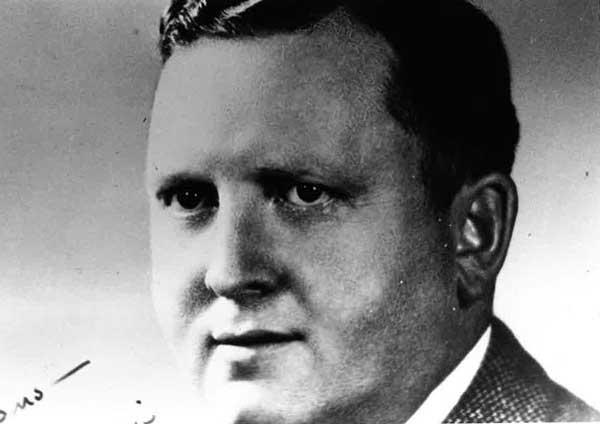
Paul Yoder, Lynn L. Sams Papers, Special Collections in Performing Arts, UMD
Don Gillis Interviews Paul Yoder, March 2-7, 1965
American Bandmasters Association Research Center, Special Collections in Performing Arts, University of Maryland, College Park
Transcription by Christina Taylor Gibson
Paul Yoder: This is Paul Yoder talking to Don Gillis.
Don Gillis: I’m talking with the former president of the American Bandmasters Association, we’re sitting in a hotel room in the Mayflower hotel in Washington, D.C., Paul Yoder. Welcome Paul to these microphones.
P.Y.: Mighty glad. Mighty glad to be here.
D.G.: And, uh, I probably will be very trite in asking questions, although I try not to be, uh, no pun intended on the business of trite. You commenced writing music a great long time ago, and you’re still a very young man so you must have been awfully young to start.
P.Y.: Well, thank you very much. I’m 56 right now. I started writing when I was in college. When I was playing in the band became interested in what the band sounds like and my writing took a light and humorous character and received a certain amount of attention and I graduated from the University of North Dakota 1930 after playing with the band there and serving as assistant conductor. My father was always an educator and he secured me a teaching position in Aurora, Illinois, and it was there that I took my cornet and my clarinet and sat behind the sections and played along from the Bennett band books and learned to realize what
D.G.: And the Melrose blues books too
P.Y.: Yes, surely I did. And realized what the fundamentals of arranging were as regards to school band. And in those days there were not as many materials for the young bands as there are now, and I had a fine opportunity to break into that field. I taught in Aurora and then I taught in Evansville, Indiana and then in 1936 I branched out on my own and I’ve been composing and arranging band music on a freelance basis ever since that time. But my primary interest is in the young band. Every band has to start. They don’t all reach the peak of perfection. And all of our students don’t stay with it. But they all start. And they all have that wonderful enthusiasm that you find in a junior high school, and that’s such a wonderful place to approach these students with new music and with something that they can perform, something that will appeal to them and still something that you hope has a high enough standard to keep raising their in music a way as they go along.
D.G.: Oh, would you venture to guess, although you probably have kept track of it, how many compositions you’ve written?
P.Y.: Well, it’s something around 1,500 if you count all the collections and books that I have
D.G.: 1,500 pieces of music . . .
P.Y.: different titles
D.G.: … which are being played now
P.Y.: Oh, many of them are out of print now, you can’t find ‘em anymore, but there are some still, still around. My big success has been with the instruction books. I had this book first with Claude Smith and Harold Bachman called the Smith-Yoder-Bachman book which for thirty years has been used as an instruction book. And now I’m on a method series book which I created with Joe ??? which has been quite successful and for which there is a great demand. As I said, everybody has to start. And it isn’t everyone who is interested in the starting. Most composers are interested in writing for the finest bands that they can find, and they find the finest level of performance there, but I’m interested in the kids. And to see what they can do as they grow up. My ideal is to make a young band sound as well or even better than they actually deserve to sound.
D.G.: Paul, you said a moment ago that you were 56 years old, and I can almost join you, uh, but I was in the Texas Christian Band in 1930 and it seems to me that we played Paul Yoder arrangements during those days.
P.Y.: They were in existence.
D.G.: And I remember that when I first saw you I thought that Paul Yoder would be at least 109 years old. I thought maybe you were the composer’s son.
P.Y.: That’s like the boy across the street. He came home with an instruction book that had my name on it and his mother says, “You know that’s written by Mr. Yoder across the street!” and he says “It’s not, it’s written by somebody dead.”
D.G.: [laughter] Composers are supposed to be dead!
P.Y.: Yeah, ‘sposed to be dead!
D.G.: Well, I think it’s not only a magnificent contribution—I’ve played ‘em and I’ve conducted ‘em and I loved ‘em—and, uh, I could put in here too, always a little bit jealous of this man Yoder with his deft and amazing originality he steals the program after you’ve just finished a symphony, here comes a Yoder number where people really enjoy it! [Yoder laughs]
P.Y.: Well, you’re being very kind. I would like
D.G.: Being very truthful.
P.Y.: I would like to say, Don, I have a serious side, which most people don’t know about. I’m very deeply concerned about the band and sincerely interested in the band, and I’m so delighted to see the progress that the band has made. In my opinion, the band is the most versatile music medium that we have. We’re so proud of the circus band, the minstrel show band, and the church school band. Of all our bands in the military. Of all our bands in the schools and colleges. And they have to do an amazing number of things. When President Kennedy died, the first ones they called on were the service bands of Washington to take part in that ceremony. They have to do all kinds of things! Our college bands have risen to an amazing place of perfection, are amazing performers. The band, the serious band is now the champion of the American composer, you know that.
D.G.: Yes
P.Y.: Because they can get performances! These men who are our finest writers, who have been concerned with the orchestra and the choir are concerned with the band! Not because they want to make money, you know how that goes, they want their music to be heard! And we have fine bands and intelligent conductors coming out of colleges every day now. And that’s what’s encouraging a flood of fine music. Now that will all have to stand the test of time. We don’t know how long these new pieces will around, and we still know, and we saw at this convention that the wonderful transcriptions from Wagner and Richard Strauss and the composer of Mass in A that we heard right here, still have a wonderful place in the band literature. The band must cover the whole field. But there is some reason why 50 thousand school bands exist in this country. Why 17 million students are playing instrumental music in this country. It’s not just the football game on Saturday afternoon, it’s a real art form that has been felt in the grassroots of this country. In the bandstands at the highest peak of its potentiality right now.
D.G.: Well, it’s indigenous, it’s ours, we created it.
P.Y.: We created it and we must see that it progresses and goes ahead without losing any of Mr. Sousa or any of the fine tradition we have in our background, we must be on the alert for all these new things that are coming along. And we must let people know! All over the country! The band is not just a street parade! The band has many, many objectives! And it is doing each one better and better every day.
D.G.: Apropos of your comment a moment ago about being played by bands, I recently read a survey of the number of American compositions that have been played by American orchestras and it amount to about 7% or 8% of the total program! And heard some of my composer colleagues griping about that. You know, you can’t get performances.
P.Y.: The orchestra is very hard. You know the orchestra is based upon a standard repertoire, their people expect them to play a standard repertoire, they’re not too open to new things. The band is wide open because we do not have a large literature of original music as yet, and we’re anxious and willing to hear from anybody who has something to say. It’s an experimental status at the present time. Many of these pieces will not last. And many of them will become things that we’ll hear over and over again and take their part in the standard repertoire of the band.
D.G.: So the composer who writes now, if he really wants to hear his music played
P.Y.: He can
D.G.: Has the band available to him.
P.Y.: He can hear it any place in this country. It has marvelous organizations and intelligent conductors who will study his scores and will give him a fine performance.
D.G.: With a great deal of honor and dignity to themselves when they do it.
P.Y.: No question about that.
D.G.: You spoke about begin from, uh, North Dakota . . .
P.Y.: That’s right.
D.G.: …did you say? Well, I’m from Missouri, and it seemed to me, one of the projects which you inaugurated while you were president of our American Bandmasters Association was the, uh, Research Library
P.Y.: At the University of Maryland
D.G.: Research Center at the University of Maryland. And it just now occurred to me Paul, while I have pictures of my old town band from Cameron, and no doubt you have them
P.Y.: I do
D.G.: It must be millions of Americans who have pictures of their town band.
P.Y.: I wish they’d send them to the American Bandmasters Research, uh, Center at the University of Maryland. They would be wholeheartedly welcomed and they would take part in our permanent collection of the historical and traditional information on the band.
D.G.: I’m going to ask you to repeat that address, if you would.
P.Y.: The American Bandmasters Research Center, University of Maryland, College Park, MD
D.G.: College Park, Maryland. We’re interested in pictures and then programs if they have them?
P.Y.: Pictures, programs, clippings, uh, records, uh, anything of the wonderful, uh, tradition of the band that goes back so many years.
D.G.: Old grandpa played in the band and his uniform is still in existence, we’d even like that.
P.Y.: Yes, we’re interested in all sorts of things. We’re gonna have a wonderful collection of material there. We’ve got a story to tell. The band is by far the most glamorous musical organization! It’s the most exciting! You can’t compete with it in any other field, I can’t see. We’ve got this whole tradition of wonderful story to tell in this country if we just bring it alive.
D.G.: Well, maybe we’ll start here and get everyone interest in participating with us, not just alone in listening to the music on these broadcasts, of which there will be Yoder, of course, but also, but participating in helping assemble this
P.Y.: We’d love that. Some of this material is lying around in attics and barns. We just secured a whole collection of material about Patrick Sarsfield Gilmore, the founding father of American bands. Two weeks before this convention we got it in at the Center and we put it up in the viewing room there the day we were over at the University.
D.G.: Well I think this would be a wonderful thing if they would. Paul, uh, I am sort of fond of ending up these interviews by projecting the band into the future. You and I have been lucky to have lived through thirty of the most formative period, thirty years of the most formative period. Before, would say 1930 or 26 or Bill Tracy in Cameron, Missouri. I don’t know who your first band director was. Do you remember?
P.Y.: Bill Haysley in Grand Fox, North Dakota. Well, those, those gentlemen we pay tribute to also and the countless other heroes who began men in the bandfield who are now leaders of our great bands, but, uh, what would you say is going to happen next? And we’ll say, we’re going to be sitting in the same room, twenty years from now, in the newly redecorated hotel and at another band convention, and we’re going to talk about what’s going to happen next?
D.G.: Don, I’m just as optimistic as I can be. In the first place, the band is going to still have its home in the height of American and that we’ll have more participating people in our program than anything else. Besides that, in another 20 years we’re gonna see the concert bands being heard and received right along on the same basis as the symphony orchestra, as a few of them, such as the Michigan Band, are at the present time. And I can see nothing in the way to stop the band. We have a wonderful future in store if everybody keeps their same interest and continues to raise the ideals and the standards, there is just no end to what the band can do.
D.G.: It’s a real forward march.
P.Y.: Thanks Don.
P.Y.: Thank you.
[off mike: thank you Paul.]