
Karl M. Holvik Interview
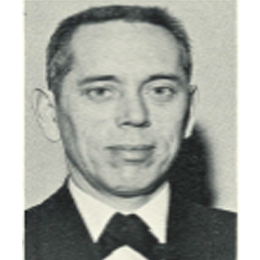
Karl M. Holvik, ABA Recording Collection, Special Collections in Performing Arts, UMD
Don Gillis Interviews Karl M. Holvik, March 2-7, 1965
American Bandmasters’ Association Research Center, Special Collections in Performing Arts, University of Maryland, College Park
Transcription by Christina Taylor Gibson
D.G.: This is an interview with Karl Holvik. We’re talking with Dr. Karl Holvik of the State Teachers’ Co- oh, I’ll start again. We’re talking with Dr. Karl Holvik of the State College of Iowa, part of the State Teachers’ College of Cedar Falls, Iowa, who’s been a member of ABA, the American Bandmasters’ Association, since 19 hundred and 57. I think, Karl, you told me that your first convention was Pittsburgh.
K.H.: Yes, I received notice of my acceptance into the American Bandmasters’ when I was out on a conducting weekend and could not come, unfortunately.
D.G.: Mm-hmm. And then your first convention was, uh, where?
K.H.: I first attended the ABA official meetings at Madison, Wisconsin
D.G.: With Dr. Ray Dvorak?
K.H.: Yes
D.G.: And one of the great big 10 bands
K.H.: Yes, sir.
D.G.: That was a marvelous convention and since that time, I think I’ve seen you at many conventions?
K.H.: I have attended most of them Don, when it’s possible to get away.
D.G.: You told me, um, a few moments ago, that you began as a band director in 1947. This makes you almost twenty years in this, uh, wonderful business of ours.
K.H.: Yes, officially almost twenty years. My father was also a bandmaster and I have two brothers who are bandmasters. Um. After the war, I attended Eastman for two years on my Master’s degree and then started
D.G.: Eastman is at Rochester, is in Rochester
K.H.: Yes, Rochester, New York. And then I started—I had the pleasure of working there under Frederick Fennel, and then started at what was then Iowa State Teachers’ College.
D.G.: And you went there as an assistant to Dr. Myron Russell who we all know.
K.H.: Yes as marching band director for three years, and, uh, taught clarinet.
D.G.: Karl, with all of this vast experience, you have been with the, in the Navy, I think you told me, or at least in the armed services, what, what unit were you with during the war.
K.H.: I was, uh, a communications officer aboard ship in the South Pacific for twenty-five months.
D.G.: And then you came to your first job. First job at school, big degree, ready to set up, uh, this marvelous business of being a band director at a great school in the mid-west and, what was the first number you conducted?
K.H.: Uh, The Star Spangled Banner.
D.G.: Almost like being in the service, again?
K.H.: Yes, exactly. Although, Don, I was not a Band person in the service, I was a communications officer and didn’t play the clarinet for over two years.
D.G.: I think you told me that your major was in, in composition?
K.H.: No, I had my Masters in Music Education and Clarinet at Eastman. And then when I got my doctorate I studied composition under the late Philip Greely Clapp at Iowa City.
D.G.: Here is a personal question, but, uh, why did you decide to become a band director? Other than the fact that, perhaps, your father was a band director?
K.H.: This decision took a long time to arrive at, Mr. Gillis. I studied music all my life, but I also was interested in social science and at college at Concordia in Moorhead, Minnesota, where my father taught, I have a major in, uh, history and, uh, also a major in music. Now, with my parents both being musicians, I rather, now as I look back upon it, my career is inescapable, but at that time, I didn’t know what I wished to do. Uh, during my service in the Navy, I had a lot of time to think, out in the South Pacific going from island to island, or, as Mr. Roberts so delightfully says, from tedium to apathy, and I had time to think, uh, what I really wanted to do. And decided, at that time, to attend a music school, and to see if I had the talent, and the real desire to, uh, become a bandmaster.
D.G.: Mmm-hmm. And, you know, it’s very unusual in this business of being a bandmaster to stay in the same school for so many years Karl, you’re to be congratulated on that and, also, I think, is the school to be congratulated. You became not just the assistant bandmaster, but the full bandmaster of the school in what year? Do you remember?
K.H.: I left for a year, 50/51, to establish residence in Iowa City to study composition. Incidentally this same year Dr. Russell was at Michigan, getting his doctorate. He came back to become department head in 1952 at which time, he asked me if I would take over the band program, become director of bands. And then I had a marching band and the concert band. And since that time, I’ve have the pleasure of hiring two very talented assistants, who work with the marching band, the varsity band, the basketball bands, the stage band, as the program grows, we now have three men on the band staff.
D.G.: Well, I know a great deal about your reputation in the field. Uh, you’ve been associated with a number of educational organizations which have done great work for bands, uh, the Iowa Bandmasters’ Association, for example. Were you not, uh, past president? Or what? I, I know you were a high official in that organization at one time.
K.H.: Yes, I had the pleasure of hosting the convention in 1957. I was president ‘56 and ‘57 at which time you and I had much pleasant correspondence about this business of bands and band music. And then, after that, I served the College Band Directors’ national association as division secretary, division chairman, north central division, and, uh, currently, as chairman of their committee on published band music, a position which I’ve held since 1958.
D.G.: You know Karl, the average American, uh, comes into contact with band, uh, very early in life. He can’t remember a time when there wasn’t a band of some sort. Either in his high school, Jr. high school. How many people do you suppose in America, have played band instruments in the last thirty years would you say? Just hazard a guess.
K.H.: Ooh, Don, I couldn’t guess. In the hundreds of thousands. Perhaps millions! Uh, the American Music Conference has some interesting statistics on this. And I can hardly believe them! But as you travel around the country, and as you see all of these magnificent organizations, at all levels and in all areas, it’s, uh, it’s very impressive, the number of people who are participating, at one level or another, in this American band situation, which is uniquely American. There is nothing like this anywhere else in the world!
D.G.: Well we know, from statistics that there are approximately 26,000 bands now. What was it like seventeen years ago or eighteen years ago, when you first started? How many do you suppose there were?
K.H.: Oh, a fraction of that number. It was my pleasure to play, in a band, all through high school and in college, but the bands by today’s standards were very humble. The music, uh, was just beginning to become available. We played symphonic transcriptions, marches, serenades, accompaniments. But in, in the short time that I’ve been in this business, we’ve seen a magnificent growth of repertory, technical facility, musical facility on the part of our students, and beautiful instruments which they have to play, and marvelous music, which is now available for band. Uh. It’s almost unbelievable, just in fifteen years what has come about!
D.G.: The half time shows at football games or the band marching down the street to dedicate a new monument of some sort, this is not really the important part of your musical life, is it?
K.H.: I think though, in a way though, that it is, because this is what the public knows. When you say, a band, to the general public, you know, they play at parades, they play at football games and on any given Saturday in our town we play for seven or eight thousand people. We play each year in Chicago for fifty thousand people plus the national television audience. We cannot begin to reach this number of people in our concert halls, just for the sheer vastness of the audience we can reach on the marching field, in a parade. I think these things are still very important.
D.G.: I see we have the phone ringing in the background as we talk to you here, which is part of the naturalness of this interview being held at the 1965 convention of the American Bandmasters Association, where we’re doing these interviews with various members of the American Bandmasters Association. Lemme ask you one question: when we talk about American Bandmasters, we remember that this was started by Dr. Simon and, uh, I think the John Philip Sousa was at the first convention, Arthur Pryor, some of the great names in, uh, band music, and, of course, Dr. Edwin Franco Goldman, who, was the first president of our organization, was he not?
K.H.: Yes.
D.G.: Uh. Things were so different then than they are now, there was so much professionalism in bands and less, so much less of that now, the, the, college and high school band have rather replace the municipal and professional band, have they not?
K.H.: I think this is true, that the emphasis now, just in terms of sheer numbers of those directing and playing, uh, has been centered pretty largely in the educational world at all levels. But we must not forget the magnificent heritage that we have accepted, that we have gathered from these magnificent men who pioneered this movement. I was very young when I first heard Sousa and his magnificent band. I was so young that I have only a vague memory of the fact that in the center of the room was a chandelier. I later learned that this was the crystal ballroom in Fargo, North Dakota, but I was so young that I cannot remember the band, except that it was great. I cannot remember anything about what they played. My father took me . . . I was very young, but what has happened since those days . . . it’s almost incredible and, uh, what we owe to these men who developed the band program with new music, other than marches, with very few players, mostly European trained, uh, the conductors, largely European trained with their Italian, French, and German backgrounds, English. These magnificent men had the faith that the band was more than a military organization, more than something to march us off to war and to play on the fourth of July and Memorial day. It was more than this. And from these magnificent men, we have continued to grow and develop to what we have today which is truly magnificent, uh, music situation involving hundreds of thousands of young people and all kinds of talent—composers, authors, arrangers, manufacturers—it’s difficult to believe that all of this has happened in such a short time.
D.G.: You lead me very naturally into a question, Karl, about the literature now not of the marching band at all, because we all know that it is restricted mainly to that form of music which is operative to marching. But now let’s come to you and your concert band. We know that the styles have changed drastically since the time of the founding of this organization, but could you just, off of the top of your head give me sort of a sample program which you might have done with one of your bands in your concert series.
K.H.: Well, I’ll tell you what we played just two weeks, three weeks ago, when we came back from tour. We opened with the Mozart Marriage of Figaro, we played an overture other than this, the Westley Sheppard arrangement of Ruy Blas of Mendelssohn, we played as a closer . . .
D.G.: Was this the same arrangement that we heard the other night on our concert, the other afternoon the Ruy Blas?
K.H.: Umm, very possible, yes, by Westley Sheppard, who is also a bandmaster. Uh. We closed with a very exciting, relatively new work by John Barnes Chance called Incantation and Dance and this piece, with its tremendous power and drive and imagination was a big hit on the whole tour. It’s very difficult. Rhythmically very exacting. Uh. We played some quiet music, uh, we played some Bach . . .
D.G.: Did you play some Latham? Isn’t Mr. Latham a member of your own faculty? And we’ve had at least two of his own worked represented on our 1965 ABA convention programs.
K.H.: Dr. Russell conducted his uh, “Swinging Reel” which is uh tongue and cheek. Delightful novelty. I had the pleasure of conducting his quiet tune, which he wrote for me, and, uh, had the pleasure of doing that here with the University of Maryland band.
D.G.: So the literature has expanded from the half-page band folio sized thing to now, uh, something of a including . . . they still write marches don’t they?
K.H.: Oh, yes! Thank goodness! What is a band without a march? You cannot play concerts without marches. We have the pleasure in our state of having not only Dr. Latham, who is our very fine colleague, but, still alive, thank the Lord, Dr. Karl L. King, one of the original inspirations of this whole band movement.
D.G.: They named a bridge after him recently . . .
K.H.: Oh, heavens. You walk, you drive to Ft. Barge(?) Iowa! It says on the Chamber of Commerce sign, “home of Karl L. King”
D.G.: Oh, wonderful.
K.H.: This man is so loved and so revered throughout the world! It’s a pleasure for us to know him personally and to have his permission to have at our college, upon his death, the Karl King memorial library.
D.G.: I’d like to ask one more question, before we close this very pleasant chat with you here in very pleasant room in the Mayflower hotel here in Washington, D.C. in the 1965 convention. You’ve been a band director now for seventeen active years and the thought has been in your mind years before you became a band director. How would you project your career, let’s say, twenty years from now? What do you think the band field will be in twenty years?
K.H.: [sigh] Oh, I don’t …
D.G.: It’s a large question, I see you breathing heavily as you try to answer it.
K.H.: I, right now I am thinking forward to the, uh, 19th of February, 1966 when we shall host the convention and that’s consuming all of my thinking at this point. Twenty years. Well, if we could possibly make the progress, musically and artistically, in the next twenty year that we’ve made in the past twenty years, I would not dare predict what we could do. All that I ask is that we don’t forget two things: we don’t forget that we play for people. And that we don’t forget that we conduct people. Once we forget either of these two things, we are on the wrong track. The talent is there. The audience can be there. It’s our job to see that these two things are taken care of. So long as there is music, people will write it. So long as there is music, people will play it. But we must have, also, the third side, of the, of the triangle: the audience. We have the re—we have the creator, we have the re-creator, and we must have the listener, our American public. We owe to them so much that we will see also in the next twenty years what we are doing also for them.